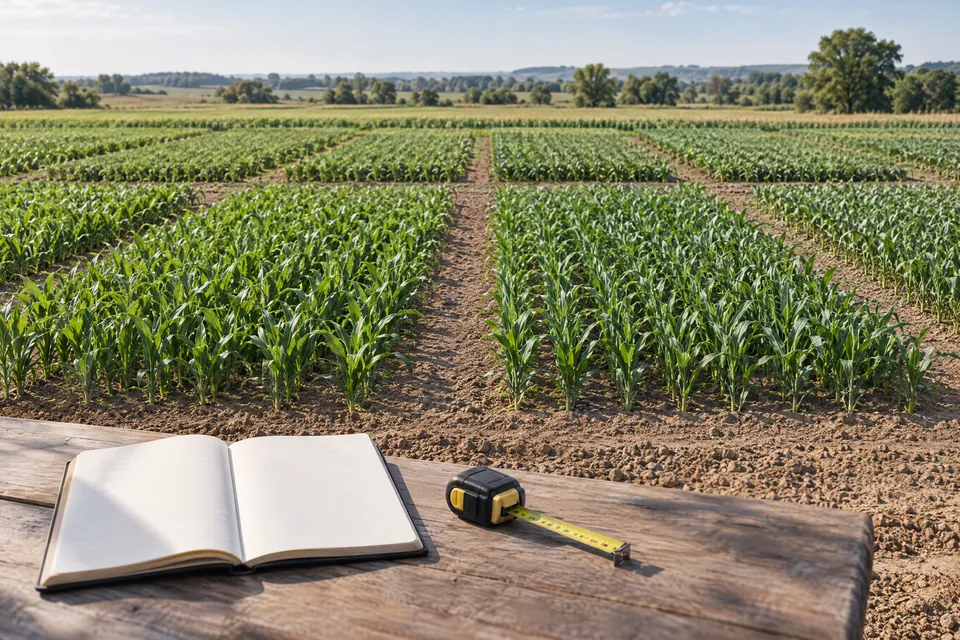
A small-plot comparison can help a grower decide whether an agricultural SAP treatment deserves further evaluation. It should answer a defined question under the farm's conditions, rather than attempt to prove every possible benefit in one season. The plan needs to distinguish the material, its application and the rest of crop management.
Choose the crop question
Maize, wheat, potatoes and field tomatoes have different planting systems and production objectives. Select the crop and the period of concern first. The question may concern establishment, root-zone moisture during a dry interval or the operating demands of irrigation.
Define the observation before applying the product. “Does this change establishment under these conditions?” is more interpretable than a general claim that a treated field will perform better.
Document the treatment
Record product identity, batch where available, particle grade, application amount, preparation, placement and timing. Use the selected product's instructions to design the procedure. Do not transfer a seed-furrow, seed-coating or root-treatment method from another product without checking its suitability.
Record soil conditions, crop variety, planting date, water source, fertility and other management. Keep them comparable between areas unless a difference is deliberately part of the trial. Mark areas clearly and retain the layout with the records.
Measure the conditions as well as the crop
Rainfall, irrigation and the occurrence of the intended stress period are essential context. Where practical, include soil-moisture observations, establishment, plant condition and the crop outcomes relevant to the purchase decision.
Use a consistent area and measurement basis. A photograph is useful documentation, but colour or plant height alone does not establish yield, quality or economic return. Retain neutral and unfavourable results as well as positive ones.
Decide what comes next
Review performance alongside the cost of material, transport, handling and application. A promising observation can justify a further comparison; it does not automatically establish a rate or result for another farm, crop or season.
Should irrigation be reduced immediately? Do not impose a generic reduction. Scheduling changes should be deliberate, recorded and appropriate to crop conditions.
What if the expected dry period never occurs? Report that limitation. The trial may still show whether the product can be handled and incorporated with the available equipment.
Is one treated strip enough for a broad claim? It can be an initial practical check, but field variation and repeatability need consideration before drawing wider conclusions.
Share your crop, field conditions and trial objective with ZJFunder to discuss agricultural SAP information and sample selection.