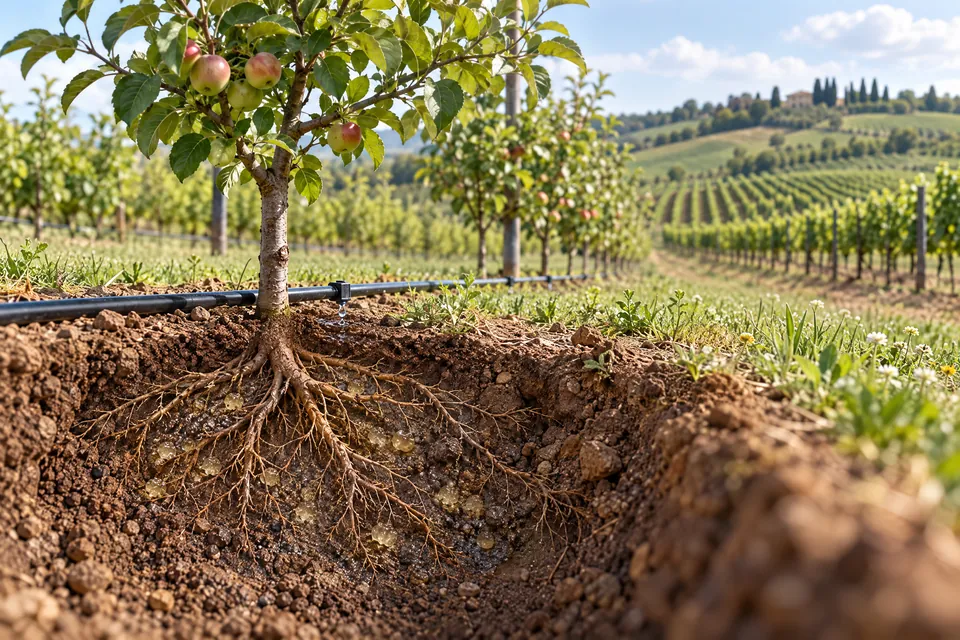
A potassium-based water-retaining polymer may be evaluated for orchard and vineyard root zones, but new plantings and mature blocks need different application plans. For new trees or vines, review the root ball, backfill and aftercare. For established crops, confirm practical placement without unnecessary root disturbance and relate it to emitter wetting patterns before choosing a grade or estimating quantities.
Separate establishment from mature production
For a newly planted tree or vine, discuss the root ball, planting medium and aftercare programme. The practical question may concern moisture during establishment. For mature production, the question may instead concern irrigation management within an existing root system and cultivation programme.
The difference affects access and incorporation. A material that can be mixed during planting may be difficult to place later without disturbing roots. Confirm the feasible method before selecting a quantity for an entire block.
Connect the treatment to the wetted area
Describe emitter positions, water distribution and the soil area that is actually wetted. Root-zone placement should be considered in relation to that pattern, not chosen solely from the canopy outline or a generic planting diagram.
Product instructions and site conditions determine the procedure. Circular and strip placement can be discussed as different concepts where relevant, but this article does not prescribe trench dimensions, a universal position or an application rate.
Keep observations relevant to the business decision
In establishment work, record plant condition, irrigation and aftercare labour over a defined period. In a producing block, include the crop outcomes that matter to the operation alongside water and labour records. Do not infer fruit quality or marketable output from a change in watering frequency alone.
Compare representative sections with similar soil, crop age, variety and management. Record deviations such as repairs, emitter changes or local soil differences. A result becomes more useful when the conditions under which it occurred remain visible.
Frequently asked questions
Can an existing orchard use the same procedure as a new planting? Not automatically. Root access and practical incorporation can differ substantially.
Does a laboratory absorption figure establish an irrigation interval? No. Scheduling depends on the crop, weather, soil and the complete water-management system.
Can one block establish a result for every orchard? It provides evidence about that application and season. Broader use needs an appropriate review of transferability.
Contact ZJFunder with the crop, planting stage, soil and irrigation layout to discuss SAP options for an orchard or vineyard evaluation.