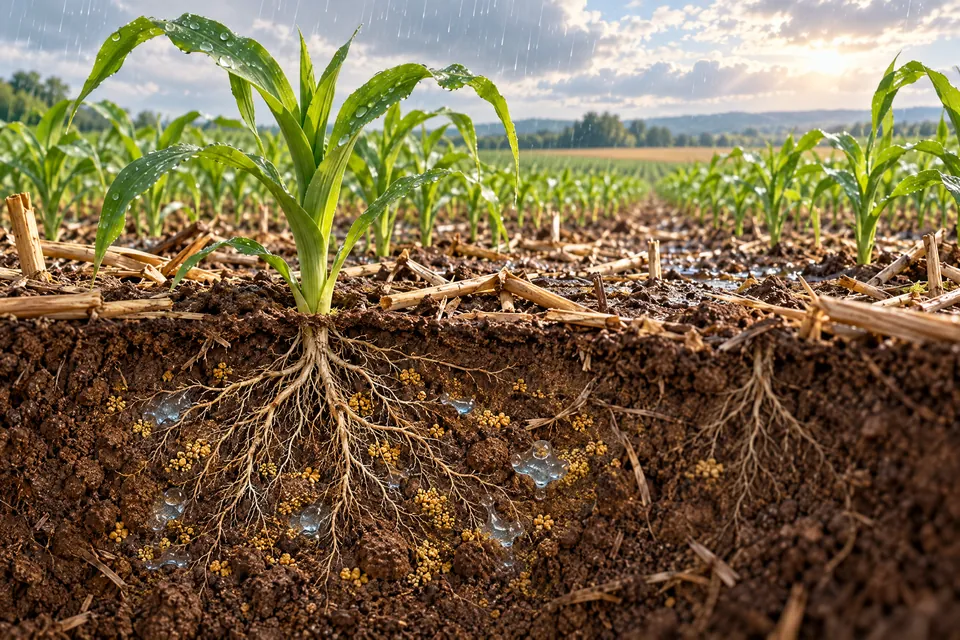
Rainfed farming depends on more than the amount of rain recorded over a season. When rain arrives, how it enters the soil and how long moisture remains accessible to roots all influence the growing conditions between rainfall events. Agricultural superabsorbent polymer, or SAP, can be considered as one component of that water-management system.
Start with the gap that matters
A grower may be concerned about establishment after sowing, a recurring dry interval or a sensitive crop stage later in the season. These are different problems. Identifying the difficult period makes it easier to decide what a water-retention treatment needs to achieve and what should be measured.
Describe the crop, planting stage, soil profile, rooting depth and rainfall pattern before selecting a product. A field with poor infiltration needs a different discussion from one where rainfall enters readily but drains rapidly below the active roots.
Give each measure a clear job
Surface residue and mulch help protect the soil surface. Infiltration and runoff management influence how rainfall enters and moves across the field. Agricultural SAP is intended to absorb water and release a portion as the surrounding environment dries. These functions are related, but they are not interchangeable.
SAP does not create water. It needs rainfall or another water source to hydrate, and its behaviour depends on the material, water chemistry and growing conditions. Particle grade, application method and placement should therefore be considered together, using the instructions for the selected product.
Make a field comparison interpretable
Compare representative treated and untreated areas under similar crop and management conditions. Record rainfall, application details, soil-moisture observations and crop establishment. Where feasible, repeat the comparison rather than relying on a single patch of ground.
In a fully rainfed system, the useful question is not how many irrigation cycles were eliminated. It is whether the treatment changes root-zone moisture and crop observations during relevant dry intervals. If the season remains wet, the comparison may provide handling information without answering the original drought question.
Questions before a trial
Can SAP replace rainfall or irrigation? No. It stores water supplied to it; it is not an independent source of water.
Should mulch be removed? Not simply because SAP is being considered. Review surface protection and root-zone retention as separate parts of the field plan.
What should a buyer send first? Crop, soil, water information, planting stage, the difficult seasonal interval and the scale of the proposed comparison.
Discuss your growing conditions with ZJFunder to review agricultural SAP options and the information needed for a relevant sample evaluation.