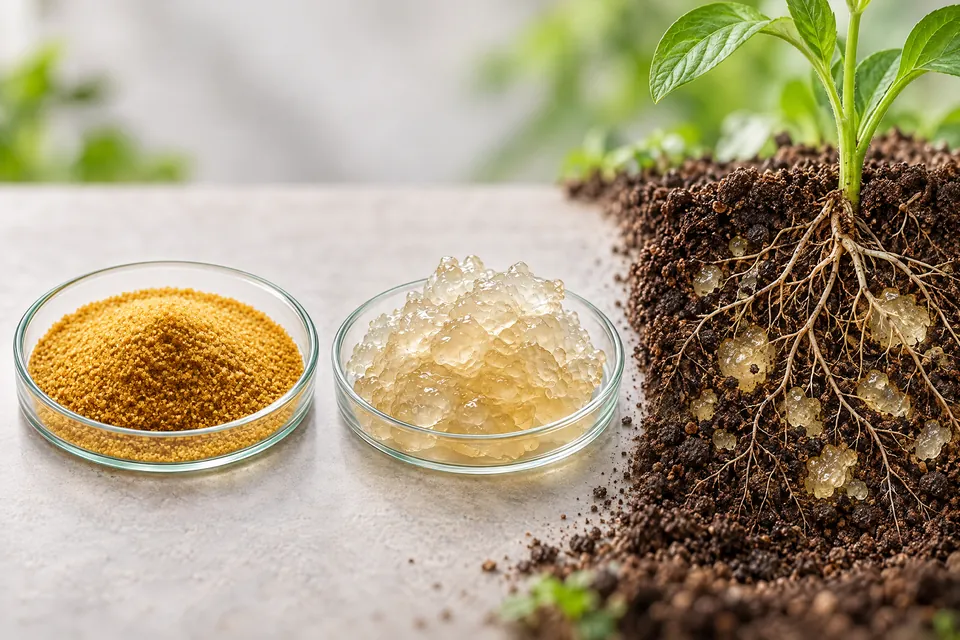
A potassium-based water-retaining polymer absorbs water, swells into a gel and can make some retained moisture available as the surrounding root zone dries. For procurement, check formulation, particle grade and intended use alongside the absorption test conditions. Read the technical data sheet, safety data sheet and relevant batch or test information together; laboratory absorption alone does not establish field performance.
Separate a material test from an application result
An absorption figure needs its test conditions. Water composition, the test method and the environment around the material influence how a result should be interpreted. A number measured in one solution should not be relabelled as the amount absorbed in every field soil.
Crop performance is a separate question. Establishment, irrigation requirements and saleable output involve the crop, soil, weather and management as well as the material. Compare product data and application evidence for the questions they actually answer.
Check formulation and particle grade
Products described as water-holding crystals are not automatically interchangeable. Confirm the intended agricultural use, formulation, particle range and application instructions for the item being offered.
Potassium- and sodium-based descriptions help identify materials, but they do not replace a complete specification. A potassium-based label alone is not proof of no salinity effect, unrestricted crop suitability or long-term safety under all conditions. Review the relevant product information and the water environment rather than selecting from the name alone.
Read the supporting documents together
A technical data sheet describes product specifications and stated properties. A safety data sheet addresses handling and safety information. Batch information and test reports answer other questions. Check product identity, revision and the relationship between each document and the material being selected.
Also confirm how particle grade and preparation fit the proposed medium and placement. Do not transfer an application method from a different formulation because both materials form a gel in a glass of water.
Make samples useful
Document the sample identity, water source, preparation and observations. A hydration demonstration can help explain the dry-to-gel change; a relevant medium or crop comparison is needed for an application question.
Does the largest advertised absorption figure identify the best product? Not on its own. The test conditions and intended use need to match the purchasing question.
Is repeated swelling the same as recovering material from soil for reuse? No. Rehydration behaviour and physical recovery from a planting medium are different issues; do not assume a general recovery procedure.
Can SAP replace irrigation or fertilizer? It should be selected for its water-retention role, with the rest of crop management considered separately.
Ask ZJFunder for the agricultural SAP specification and available documents relevant to your application.