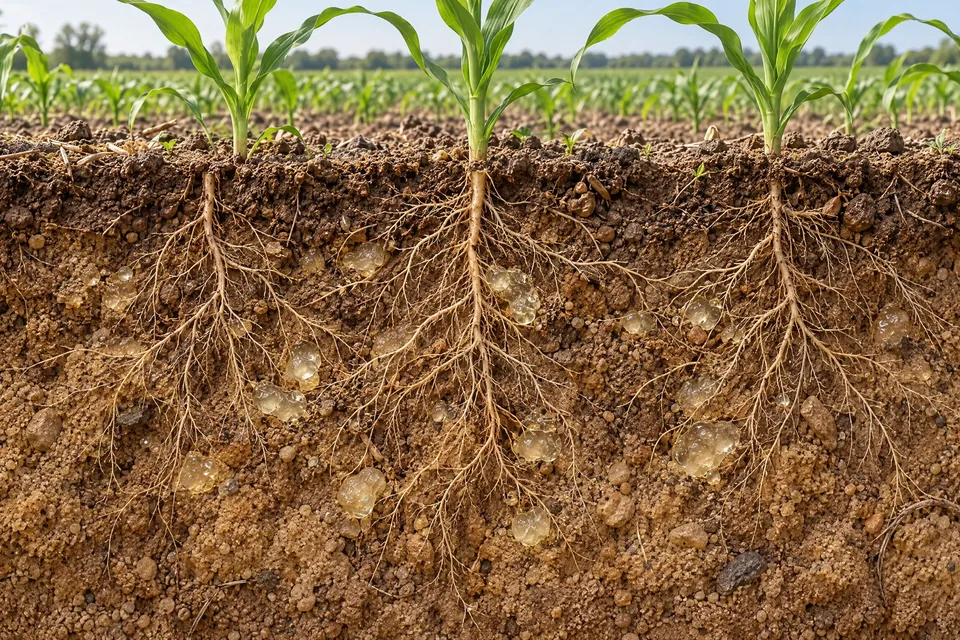
For sandy and sandy-loam soils, assess a potassium-based water-retaining polymer where limited root-zone water retention is the identified problem. Start with the soil profile, rooting depth, irrigation pattern and actual water quality, then confirm grade and placement within the wetted root zone. Pure-water absorption figures alone cannot set a field rate or establish suitability for an existing planting.
Identify what the soil is doing
The description “sandy soil” is a useful starting point, but it does not explain the complete growing environment. Consider the soil profile, organic matter, rooting depth, irrigation wetting pattern and the interval between water applications or rainfall events.
Also distinguish water retention from other limitations. Nutrient supply, salinity, compaction and poor establishment can require different measures. SAP is not a substitute for diagnosing those problems, nor should it be presented as a universal soil-reclamation treatment.
Match the material to the application
Compare the intended agricultural use, formulation, particle range and application guidance for the candidate product. Ask how it is prepared and incorporated, and whether the available supporting information addresses the conditions relevant to your operation.
Water chemistry deserves attention. Pure-water absorption data describe one test condition; they do not establish the amount retained in every soil or irrigation solution. When water quality is an operational concern, include the actual water source in the compatibility discussion.
Put placement beside the irrigation pattern
A water-retention treatment must be considered in relation to the roots and the area that is wetted. A product placed outside that area may not address the reason it was selected. Confirm placement and preparation against the selected product's instructions rather than using a generic depth or application rate.
For an existing planting, discuss what incorporation is practical without unnecessary root disturbance. A procedure intended for soil preparation before planting cannot automatically be applied to an established crop.
Build the purchase around a relevant comparison
Record the product and batch, soil description, preparation, measured application, water source and management programme. Compare representative areas and retain the observations alongside weather and irrigation records. Include handling effort and application cost in the review.
Does sandy soil always need the highest rate? A rate cannot be selected from soil texture alone. Follow the product guidance and account for crop, placement and water conditions.
Can SAP replace organic amendments or fertilizer? It should be assessed for its own water-retention role, not assumed to perform the other inputs' jobs.
Send ZJFunder your soil and irrigation information to discuss suitable agricultural SAP grades and the documents available for selection.