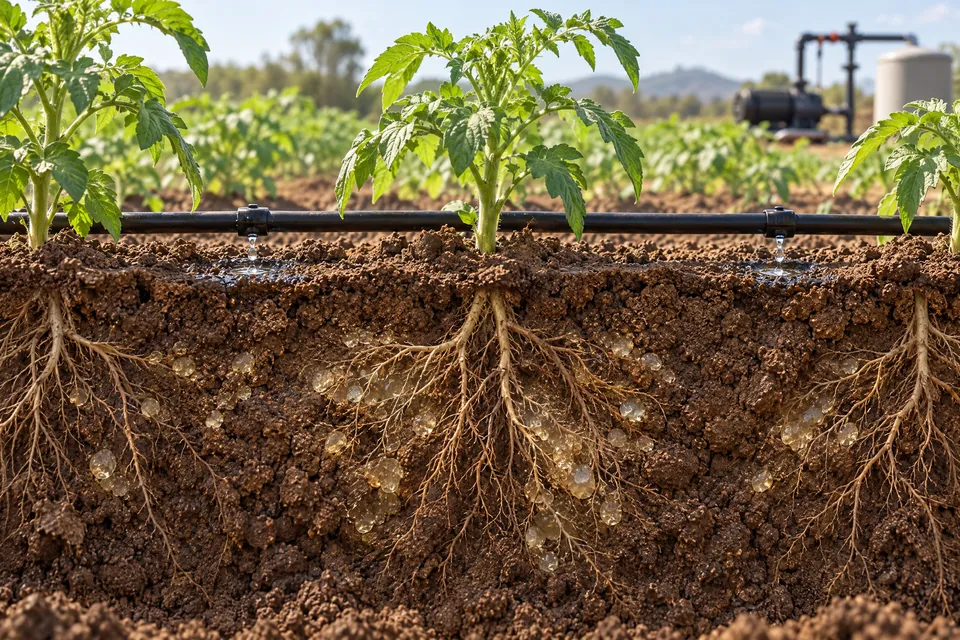
Drip irrigation delivers water; a potassium-based water-retaining polymer is evaluated for retaining it in a suitable root zone. To assess their combined cost, confirm placement within the emitter wetting pattern and compare measured water use, pumping energy and labour over the same area and period. Subtract material, freight and application costs from measured savings; fewer irrigation events alone do not establish a financial return.
Define the operating baseline
Record the current irrigation frequency, duration and delivered volume. Include the area served and the crop stage. A shorter list of watering events does not establish lower total water use if each event becomes longer or delivers more water.
Pumping costs need their own measurements. Fuel use or electricity consumption may be more informative than pump starts alone. Include labour where it changes, and separate fixed system costs from expenses that actually vary with irrigation.
Relate placement to the wetted root zone
The candidate product's preparation and placement need to fit the soil, roots and emitter wetting pattern. A material outside the wetted area may not serve the intended purpose. Confirm the practical incorporation method using the selected product's guidance before estimating a whole-block requirement.
Do not impose a generic reduction in irrigation as soon as the material is applied. Any scheduling adjustment should follow crop conditions and a recorded evaluation plan, with the other management inputs kept comparable.
Use a transparent calculation
For a consistent area and observation period, calculate operating-cost savings as the baseline variable irrigation cost minus the comparable treated cost. Then subtract the added material, transport, handling and application costs.
If crop revenue is included, calculate it separately from actual saleable quantity and realised price on the same basis. Do not assume a yield or quality premium to make an otherwise incomplete calculation positive.
An illustration of the calculation is not a customer result. Likewise, a change in irrigation frequency is not automatically the same percentage change in water, fuel or net return. Keep the measured quantities visible so another person can reproduce the calculation.
Review the whole season
Weather and crop stage can change both water demand and the apparent value of a treatment. Retain the timing of the observations and report any limitations. A useful comparison may support further evaluation, a revised application or a decision not to expand.
Does SAP replace drip equipment? No. Delivery and retention are separate functions.
Can savings be calculated from fewer pump starts? Not reliably without knowing runtime, flow and energy or fuel use.
Should future seasons be treated as cost-free? No. Do not assume product lifetime, physical recovery or repeat performance without relevant supporting information.
Send ZJFunder your soil, irrigation system and comparison objective to discuss agricultural SAP selection and the inputs needed for an operating-cost review.